Job Shop Scheduling: How to Stop Missing Delivery Dates
Late deliveries are the silent killer of job shop reputation. You can produce the best parts in the region, but if you miss the date, the customer remembers the delay — not the surface finish.
The frustrating part: most late deliveries aren't caused by incompetence. They're caused by a lack of visibility. You can't manage what you can't see, and most job shops are scheduling from a whiteboard, a spreadsheet, or the shop foreman's memory.
This guide covers practical scheduling strategies for job shops with 5 to 50 employees — shops too big for "winging it" but too small for a dedicated scheduling department.
Why Job Shop Scheduling Is Harder Than Production Scheduling
Production scheduling (high-volume, repetitive) is a solved problem. You calculate cycle times, multiply by quantities, and allocate machines. The work is predictable.
Job shop scheduling is fundamentally different:
- Every job is different. Different parts, different operations, different materials, different quantities.
- Routings vary. One job might be mill → lathe → grind → anodize. The next might be saw → weld → paint.
- Setup times dominate. In a production environment, setup is amortized across thousands of parts. In a job shop running 5- or 50-piece lots, setup can be 30–60% of machine time.
- Interruptions are constant. Rush jobs, material delays, machine breakdowns, rework — any of these can cascade through the entire schedule.
- Capacity is shared. Your 3-axis mill is needed by four different jobs this week, each with different due dates and priorities.
The result: job shop scheduling is a dynamic, multi-constraint optimization problem that changes every day. No static Gantt chart survives first contact with the shop floor.
The Three Scheduling Mistakes That Cause Most Late Deliveries
Mistake 1: Scheduling Backward from the Due Date Without Buffer
The most common approach: the job is due Friday, it needs three days of machining, so start it on Tuesday.
The problem? This leaves zero room for anything going wrong. And in a job shop, something always goes wrong. Material arrives late. The fixture doesn't fit. The first article fails inspection. The operator calls in sick.
Fix: Schedule backward from the due date, then add a buffer. A good starting rule is 20–30% buffer time for standard work, and 40–50% for first-time parts or complex assemblies. As you collect data on actual vs. estimated times, you can calibrate your buffers more precisely.
Mistake 2: Overloading the Bottleneck
Every shop has a bottleneck — the machine or process that limits throughput. In many shops, it's the CNC mill. In others, it's the CMM (inspection), the welder, or the surface finishing step.
When you schedule without considering capacity constraints, you inevitably pile up work at the bottleneck. Jobs that were "on schedule" through the first three operations now sit waiting for the one machine or process that's backed up.
Fix: Identify your bottleneck and schedule it first. All other operations schedule around the bottleneck's availability. This is the core insight from the Theory of Constraints (Eli Goldratt's The Goal): the throughput of the entire system is limited by the throughput of the constraint.
Practically, this means:
- List all jobs that need the bottleneck resource this week.
- Sequence them by priority (due date, customer importance, margin).
- Schedule the bottleneck machine's week first.
- Fill in upstream and downstream operations around the bottleneck schedule.
Mistake 3: Treating All Jobs as Equal Priority
When everything is urgent, nothing is. Shops that don't explicitly prioritize end up with informal priority systems: whoever yells loudest, whatever the boss is working on, or whatever's closest to being late.
Fix: Establish a clear priority framework. Here's a simple one that works:
| Priority | Criteria | Rule | |----------|----------|------| | Critical | Past due or shipping today | Drop everything, fix it | | Hot | Due within 3 days, at risk | Runs next on any available machine | | Normal | On schedule, due within 2 weeks | Scheduled per plan | | Low | Due 2+ weeks out, no risk | Fills gaps in the schedule |
Post the priority list where the shop floor can see it. Update it daily. When priorities conflict, the shop foreman shouldn't have to guess.
A Practical Scheduling Framework for Job Shops
Step 1: Know Your Capacity
Before you can schedule, you need to know what you have to schedule against. Capacity planning doesn't need to be complicated:
Per machine, calculate available hours per week:
- Total hours the shop is open (e.g., 50 hours/week for a single shift)
- Minus planned maintenance (typically 2–5 hours/week)
- Minus average unplanned downtime (track this — most shops lose 5–10%)
- Effective capacity = what's left
Example: A CNC lathe in a single-shift shop with 50 hours/week open time, 3 hours maintenance, and 5% unplanned downtime has an effective capacity of about 44.6 hours/week.
If you're scheduling 48 hours of work onto that lathe, you're already late before the week starts.
Step 2: Map the Load
For each active job, list:
- Operations remaining (and which machine each needs)
- Estimated hours per operation (setup + run)
- Due date
- Priority
Sum the estimated hours by machine for the current week and the next two weeks. Compare against capacity.
If load exceeds capacity by more than 10%:
- Can any work shift to a different machine?
- Can any work go to overtime?
- Can any low-priority work slip a week?
- Should you subcontract any operations?
These decisions are much easier to make on Monday morning than on Thursday afternoon.
Step 3: Sequence the Work
Within each machine's weekly load, sequence jobs using a simple rule set:
- Critical and Hot jobs first — by due date.
- Group similar setups — if two jobs use the same fixture, run them back-to-back. Setup reduction is free capacity.
- Respect dependencies — if Job B needs a part from Job A (assembly), Job A's operation must finish first.
- Balance the floor — avoid piling all the complex work on Monday. Spread it out so the shop foreman isn't firefighting.
Step 4: Communicate the Plan
The best schedule is useless if the operators don't know about it. Options:
- Daily standup (5 minutes): shop foreman walks through today's priority list.
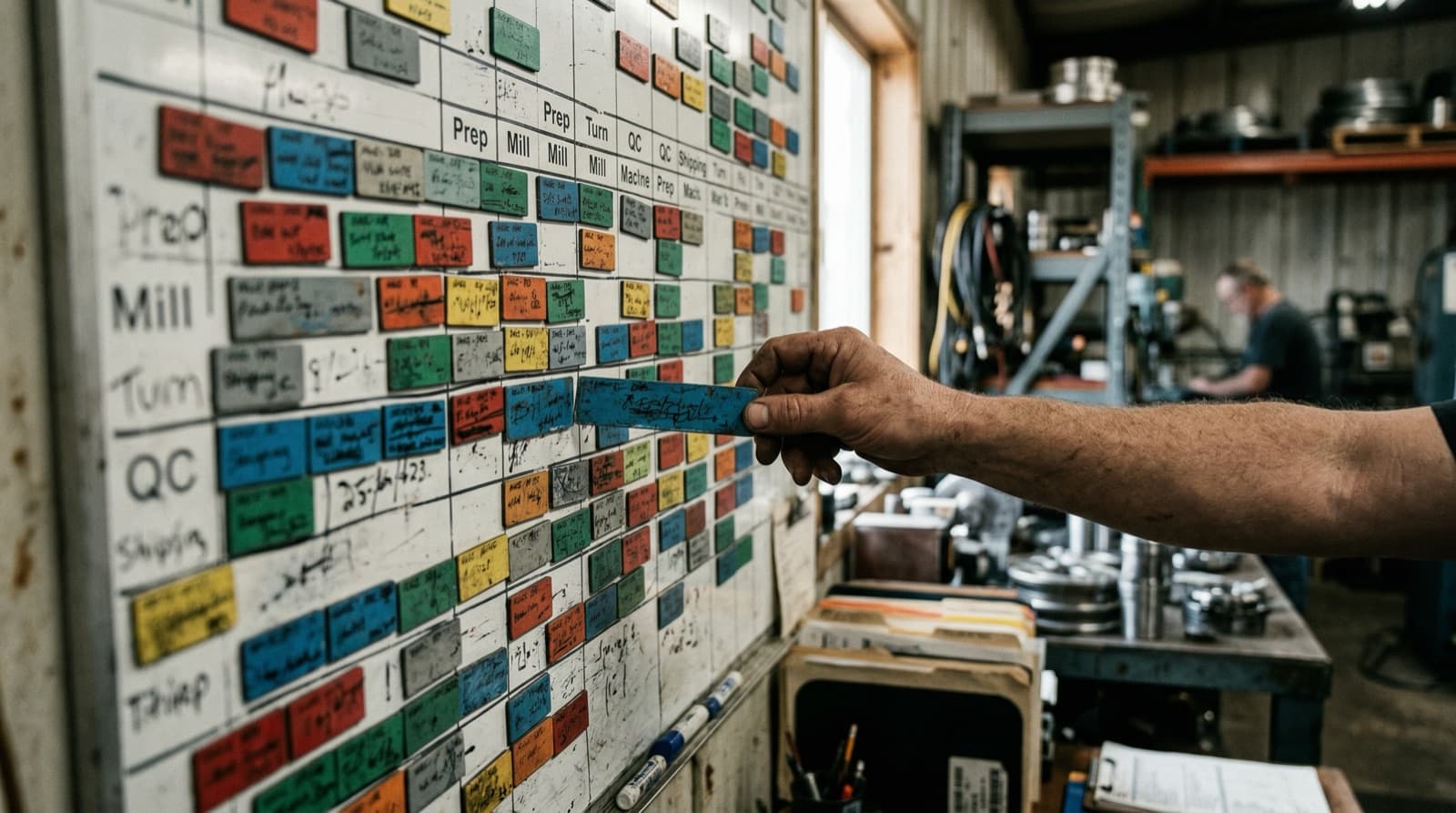
- Visual board (physical or digital): shows what's on each machine today, what's next, and what's due this week.
- Job packets: each job's traveler includes its priority, due date, and next operation.
The key is that every operator should be able to answer: "What should I be running right now, and what's next?" If they can't, your schedule isn't being communicated.
Step 5: Track and Adjust Daily
No weekly schedule survives the full week without changes. That's fine — the point of the schedule isn't to be perfect. It's to give you a baseline to adjust from.
Every day:
- What shipped? What's now late?
- What disruptions happened? (Machine down, material late, rework)
- What needs to be re-prioritized?
Update the schedule daily. A 5-minute end-of-day review by the shop foreman keeps the plan current.
Handling the Chaos: Rush Jobs, Breakdowns, and Rework
Rush Jobs
They're inevitable. A good customer needs something fast. Your strategy:
- Pre-negotiate rush terms. Rush means something gets bumped. The customer should understand there's a premium (15–30% is typical).
- Have a rush protocol. When a rush job arrives, the foreman identifies what moves to make room. This should take minutes, not hours.
- Track rush frequency. If more than 20% of your work is "rush," the problem isn't the customers — it's your lead times. Quote shorter, or qualify expectations earlier.
Machine Breakdowns
You can't prevent all breakdowns, but you can reduce their impact:
- Preventive maintenance — scheduled, not reactive. Even basic PM (lubrication, cleaning, inspection) reduces unplanned downtime by 30–50%.
- Cross-training — if only one operator can run the 5-axis, you're one sick day away from a schedule disaster. Cross-train so at least two people can run every critical machine.
- Backup routing — for your most common operations, know which alternative machine could handle the work (even if it's slower). When the primary goes down, you have a Plan B.
Rework
Rework is double damage: it consumes capacity AND delays the original job.
- Root-cause every rework event. Was it a programming error? Tooling issue? Material defect? Bad setup? If you don't fix the root cause, it will happen again.
- Add first-article inspection to your schedule. For new parts, budget time for the first piece to fail. It's cheaper to catch it early than to scrap 50 parts and start over.
- Track rework rates. If your rework rate is above 3%, it's a systemic issue, not bad luck.
When the Whiteboard Stops Working
Whiteboard scheduling works surprisingly well for shops with:
- Fewer than 10 active jobs
- 3–5 machines
- One person doing all the scheduling
It breaks down when:
- Multiple people need schedule visibility. The whiteboard is in one place. When the sales team, the shop floor, and the front office all need to see the schedule, one physical board isn't enough.
- Job count exceeds mental capacity. Somewhere around 20–30 active jobs, a single person can't hold all the interactions, dependencies, and constraints in their head anymore.
- You need to answer "what if?" What if we add this rush job? What if the mill goes down for two days? What if this material is three days late? The whiteboard can't simulate.
- You want to track on-time delivery metrics. If you don't have data on how often you hit your dates and why you miss them, you can't improve.
Scheduling software — whether a standalone tool or part of an MRP system — gives you visibility, simulation, and tracking that whiteboards can't provide.
Key Metrics to Track
If you start tracking just four scheduling metrics, you'll see improvement within three months:
1. On-Time Delivery Rate
What it measures: Percentage of jobs shipped on or before the promised date.
Target: 90% or higher. World-class shops hit 95%+.
How to calculate: (Jobs shipped on time ÷ Total jobs shipped) × 100, measured monthly.
2. Schedule Adherence
What it measures: How closely the actual production sequence matches the planned sequence.
Target: 80%+. Perfect adherence is unrealistic in a job shop.
Why it matters: Low schedule adherence means your plan is fiction. Either the plan is unrealistic, or the floor is ignoring it. Both need fixing.
3. Machine Utilization
What it measures: Actual production hours ÷ available hours, per machine.
Target: 75–85% for job shops. Higher than 85% leaves no room for disruptions. Lower than 65% means you have capacity you're not selling.
4. Average Queue Time
What it measures: How long a job sits waiting between operations.
Why it matters: In most job shops, a part spends more time waiting than being machined. If your total lead time is 10 days but actual machining is 3 days, you have 7 days of queue time — that's where schedule improvements live.
Putting It Together: A Weekly Scheduling Routine
Monday morning (15 minutes):
- Review the week's due dates.
- Check the load vs. capacity for each machine.
- Confirm material availability for all scheduled jobs.
- Identify the top 3 priorities and communicate them to the floor.
Daily (5 minutes):
- What completed yesterday? Update the board.
- Any disruptions? Adjust today's sequence.
- Any new rush jobs? Run the priority protocol.
Friday afternoon (10 minutes):
- What shipped on time? What was late?
- What caused any late deliveries? (Log the root cause.)
- What's the preliminary load look like for next week?
This routine — 45 minutes of scheduling per week — replaces hours of firefighting. It won't eliminate all late deliveries, but it will give you the visibility and discipline to drive consistent improvement.
Key Takeaways
- Job shop scheduling is hard because every job is different — but a structured approach beats chaos every time.
- Schedule the bottleneck first. Everything else flows around it.
- Buffer your estimates. 20–30% for standard work, more for first-time parts.
- Prioritize explicitly. When everything is urgent, nothing is.
- Track four metrics: on-time delivery, schedule adherence, machine utilization, and queue time.
- Communicate the plan. Every operator should know what to run now and what's next.
ForgeMRP includes a production board with drag-and-drop scheduling, work order tracking, and equipment-based capacity views. See how production scheduling works.